For many, “microlearning” is synonymous with “portability”. Over time, microlearning has increased in popularity, in part due to the convenience it affords. However, is this ease of access genuinely useful for learners?
Is portable learning just a gimmick?
As technology has developed, it’s become easier than ever to develop microlearning packages for phones or tablets. It’s one of the most frequently touted selling points of microlearning: being able to study when, where, and how you want, whether it’s on a morning commute, a lunch break, or any time you have a spare five minutes. It’s easy to see the appeal. We’re inseparable from our phones anyway, so why not be productive rather than doomscrolling?
However, there are several obvious concerns that challenge the efficacy of portable learning. For example, what’s stopping users from swapping to entertaining distractions on their phones when learning becomes too effortful? This rings especially true for educational content on social media platforms like YouTube. These platforms are designed to monopolise your attention, so their algorithms are incentivised to push tailored entertaining content. If the educational content is dry, the notion that a fun video is literally a single tap away might spell doom for the prospect of mobile learning.
Worse still, even if you remain an engaged, enthusiastic learner, what if your environment impedes your learning? If you’re studying on a morning commute, you could become easily distracted. Beyond that, is there even any evidence suggesting portable platforms are a valid means of learning?
Luckily, these concerns have answers. Let's discuss some of these now:
Microlearning platforms: curated learning
One of the reasons microlearning works well on portable devices is because content is often hosted on platforms designed specifically for learning. Mobile apps featuring microlearning content make use of features that propagate knowledge absorption and retention. As an example, our microlearning platform, IN Short, includes in-built formative quizzes to accompany our short-form video content. Furthermore, IN Short encourages users to take a break from the app after they’ve completed their learning packages for the day – the exact opposite of social media platforms clamoring for attention.
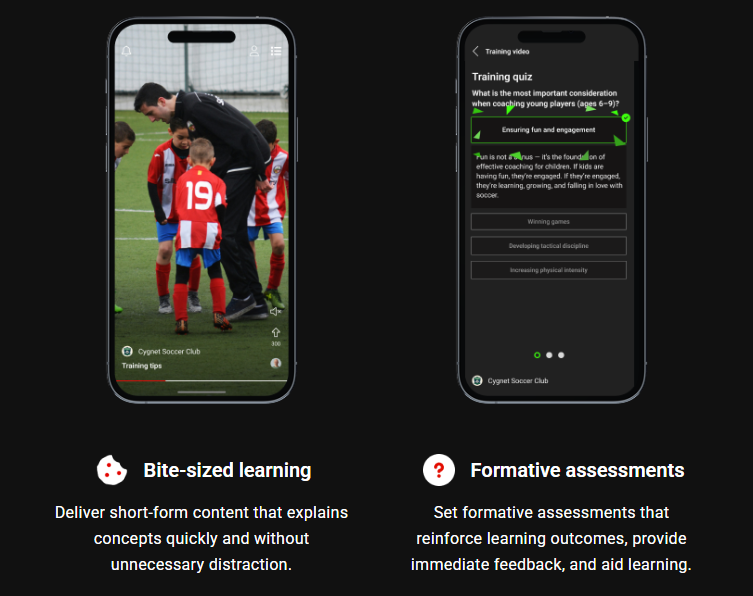
These features are backed by rigorous research: for instance, Szpunar et al. (2013) found that students who answered questions interpolated between 5-minute video lectures both performed better on further assessments on the material as well as reported the ability to focus more clearly on the content. As Brame (2016) reports when examining the same study, “students who received the interpolated questions also exhibited increased note taking, reported the learning event as less “mentally taxing,” and reported less anxiety about the final test”.
A different kind of learning environment
An understated aspect of portable learning is how the unique advantages of phones and tablets can make learning through them fundamentally better experiences than more typical forms of study. As an example, take language-learning.
Flashcards are a well-known technique that’s very commonly employed to learn new vocab when studying a language. Digital flashcard programs like Anki provide features that physical flashcards cannot emulate. For example, it uses adaptable algorithms that assess users’ retention rates in real time. If a user finds a particular word hard to remember, the app will push that word more commonly in subsequent reviews, whereas familiar words will be retested far less frequently. This modular approach to learning is a powerful tool to improve retention.
It goes much further than this. An issue that self-learners typically have when studying languages is that modern languages cannot be learned in a vacuum; you need to train your ear just as much as your eyes. Bunpro, a Japanese learning resource, uses a plethora of interactive features to address this. One of these is the inclusion of thousands of Japanese audio phrases to serve as examples as users learn content, whether it’s grammar or vocab. Of course, this is no substitute for active dialogue or proper immersion, but the additional help it can provide is undeniable.
These features, including gamified streaks, customised learning pace, practice quizzes, and a comprehensive list of external resources, aggregate into a curated study environment where highly-tailored learning is – literally – at the tip of your finger.
The unique advantages of portable learning
With all that said, what’s the difference between this and typical digital learning that you can do on your PC, aside from the added convenience of portability? The answer is that portable platforms have specific characteristics which can improve the learning experience. Continuing our example of studying languages, it's easy to see how there might be benefits when studying on mobile devices. For instance, many languages – including our example of Japanese above – involve learning different alphabets or writing systems. Many of these writing systems are complex for Westerners, such as kanji. A common technique for learning these involves the practice of repeatedly writing these characters.
It is much easier to write (or draw) with our fingers on phone and tablet touchscreens than it is to use a mouse at our desks. This is why digital artists and gamers alike often purchase tablets for increased precision when they're at their computers. The kinetic act of drawing a character on a screen, especially if it involves a stylus, mimics the familiar act of sketching on paper. When coupled with the aforementioned interactive features, it's clear that portable platforms create unique study environments that can greatly improve students' learning experiences.
More than a gimmick: the value of portable learning
This blog has illustrated how the benefits of portable learning go beyond mere convenience. Nevertheless, I think that it's still worth discussing its limitations. Critics are right to mention that portable study, as well as microlearning as a whole, is often not a complete form of learning. Our earlier example of language-learning serves as a prudent case: it would be borderline impossible – or at least, grossly inefficient – to attain true fluency in a language through isolated study. There's no replacement for engaging with native speakers or other forms of strict immersion.
Regardless, I think there's no denying the agency portable learning affords users. On top of the many advantages portable learning has to offer, the simple fact that students can learn when, where, and how they choose provides inordinate benefits. Everybody learns differently: the ability for learners to approach content through different avenues is incredibly precious.
Motivation is not the same as discipline; I don't think the motivation to learn necessarily manifests as a herculean task. It's not like going on a run every day, rain or shine: sometimes, motivation is as simple as "Sure, I would be happy to spend five minutes learning something rather than scrolling right now." Portable platforms like IN Short are valuable because they allow people the freedom to take advantage of that urge when they feel it.