So far in our microlearning series, we've covered the basics on why microlearning is likely to be important for the future of education. Today, we'll explore one of the most important problems microlearning addresses in more detail - the attention economy.
In a world where we're perpetually bombarded with information, be it useful or otherwise, and where we have interminable access to a digital universe with ever-increasing influence over our lives, it's no wonder that our attention spans appear to be on the decline. One of the primary reasons we're developing IN Short – our microlearning platform – is to empower learning by complementing the time-sensitive and attentionally-deficit nature of modernity.
However, something surprising we noticed while researching microlearning is how much confusion and, potentially, misinformation seems to surround discourse on attention span. Are our attention spans actually shrinking? Regardless, is the concept of attention span even well-defined or a useful metric?
Attention Span - misconceptions
Here's a quick example. If you've looked into attention at all, you might have heard something along the lines of "the average human attention span has declined so much that it's now smaller than that of a goldfish." Maybe you've even seen the following graphic firsthand. It comes from a 2015 report by the Consumer Insights team of Microsoft Canada. It's even the basis of an entire article in Time Magazine!
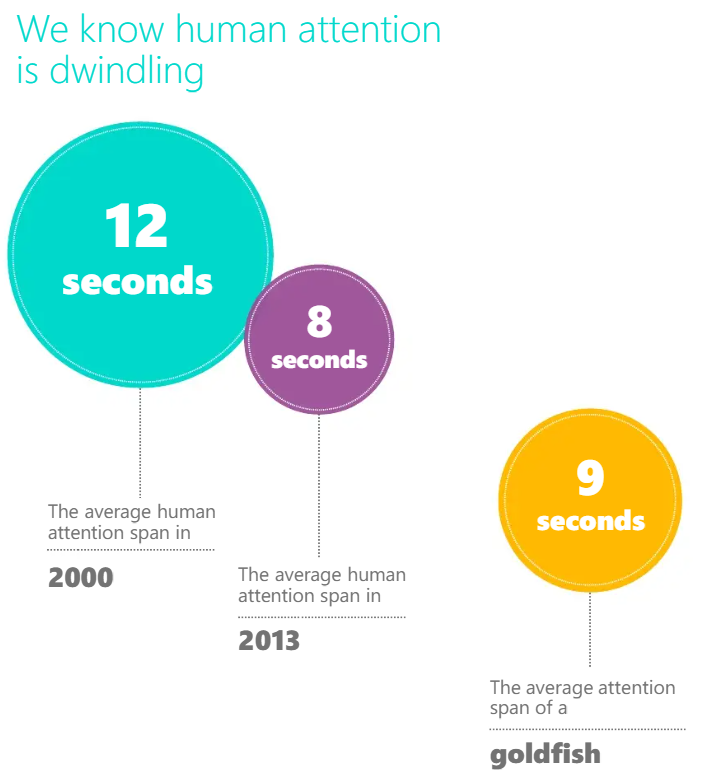
What's interesting, however, is that this particular figure doesn't come directly from Microsoft's own research unlike the majority of the report, but instead from a source called Statistic Brain, and its veracity has come under heavy fire. As stated by Dr. K. R. Subramanian in a paper discussing the myth of shrinking attention span:
"[A] BBC reporter contacted two of the sources cited by Statistic Brain — the National Centre for Biotechnology Information at the U.S. National Library of Medicine, and the Associated Press — and neither could find any research that backed up the numbers. Statistic Brain chose not to speak to the BBC reporter, and other specialists who spoke to the reporter had no idea where the numbers came from either."
It sets an alarming precedent if one of the most popular statistics on attention span can't be easily verified. Another example: a paper by Neil Bradbury discusses how several academic institutions have reduced their lectures to 15 minutes in length based on allegedly "common knowledge" on how student attention span declines past this point. The problem, he states, is the "common knowledge" in question generally traces back to a 1978 article where attention span isn't even its main subject. Instead, it's on note taking, isn't itself a primary data source – instead reviewing prior research – and one of its authors even suggests that note taking might not necessarily be a good proxy for attention!
The irony of some research on attention spans potentially including questionable, superficial citations should not be lost on anyone.
So, if some of the literature is debateable, where does that leave us, and why have we chosen to pursue microlearning as an avenue to combat purported attention deficits regardless?
Attention Economy vs. Attention Span
Definitions of attention span are nebulous. It's clear that human beings are able to focus for a lot longer than these purported figures of a few seconds. Nevertheless, it's important to acknowledge how context dictates the nuances of human attention. What are they paying attention to? How much attention is required? How effortful is paying attention? Are they likely to be distracted? Singular definitions of attention span seem to ignore this granularity. As a result, valid answers range wildly depending on how they're interpreted.
While not a perfect solution, I think it's way easier to think about attention span as a byproduct of the attention economy. Put simply: attention is treated as a finite resource, where a plethora of sources compete and vie for it as a commodity. These sources often have profit-seeking motivations to capture your attention, such as advertisers, resulting in the economics of how it can be manipulated being boiled down to a science. The ensuing cognitive strain understandably leads to frayed attention in individuals, especially as we become more and more time-sensitive.
Regardless of the cause, we can be sure that attention in the digital landscape is harder to capture than ever. As an example, here are some statistics from an article from Google:
- 53% of visits are likely to be abandoned if pages take longer than 3 seconds to load
- One out of two people expect a page to load in less than 2 seconds
- 46% of people say that waiting for pages to load is what they dislike the most when browsing the web on mobile devices
This was published in 2016 – imagine how it's changed ten years on with the advent of AI and the upsurge of short-form video content on social media platforms, such as TikTok, YouTube Shorts, and Instagram Reels.
How it ties in with microlearning
As we've established, although some of the literature surrounding attention is convoluted, both modern and historical research have plenty of enlightening insights on how it might work, synonymous with the statistics above. Nobel laureate Daniel Kahneman, in as early as 1973, claimed that attentional resources are limited, and when individuals are highly involved in a task, they allocate more cognitive resources to that task, reducing other available attention. This parallels with a modern study on how website loading animations impact temporal attention. The authors delineated two distinct types of website browsing: hedonic (enjoyment-based) and utilitarian (goal-oriented). They found that, because of the more effortful nature of utilitarian browsing, these users had heightened awareness of the passage of time and were more sensitive to website loading delays as a result.
Everything stated so far directly explains the rise of microlearning. The attention economy results in increased cognitive strain and temporal sensitivity, meaning individuals have become attracted to shorter-form, portable, accessible content. The digital landscape continually evolving has made it the preeminent environment for this kind of portability and accessibility, even though it appears to be the primary contributor toward instant-gratification bias and attentional deficit for these same reasons. Attention is a prerequisite for effective learning, so anything that competes or distracts is often a detriment to the learning experience, especially given its inherently effortful nature. The education industry is acutely cognisant of these impacts, resulting in the evolution of supplementary learning tools like gamification and microlearning.
Putting it all together: IN Short
Our own microlearning platform, IN Short, explicitly addresses these challenges posed by the attention economy. IN Short is designed to deliver learning effectively by simultaneously complementing the accessibility and portability benefits provided through focusing on short-form mobile content whilst avoiding many of the potential downsides often involved with this format.
Even though it draws key inspirations from other short-form content platforms like TikTok, IN Short is a learning platform rather than social media. It removes all the distractions associated with aggressive social media algorithms pushing addicting "content" to keep you on the app. Instead, content comes directly from trusted sources, like organisations and educational institutions you belong to, who want you to learn that package. You'll always get educational content directly relevant to you.
As a microlearning platform, IN Short has been created with the express purpose of making knowledge faster and easier to retain. Partially, this is done through interactive features like tailored quizzes. Studies show that students who engaged with interactive quiz-based microlearning modules demonstrated significantly higher attention and retention scores compared to those who used video or infographic formats. Interactivity and variety in learning helps to capture and retain the right kind of attention.
Ultimately, one of IN Short's greatest strengths is that we don't want to compete for your time, which is the biggest reason why it counteracts the issues stemming from the attention economy. There aren't any ads or in-app distractions. Fast loading speeds so you get to the content you need immediately. IN Short is designed to make the learning experience as streamlined as possible. We want you to learn what you need, when you need it, and when you're done – you're done.