Previously, we’ve seen that studies have focused on how leaderboards impact performance and engagement in learning. However, most of the leaderboards implemented in these academic experiments are often rudimentary. Leaderboards in online gaming, by contrast, have evolved drastically over several decades. Here, we will explore three simple cases of how developers have improved leaderboard design: online ranking systems, hybrid leaderboards, and supplementary gamification. We’ll also see how instructional designers might take inspiration from each of these by using Interserv’s leaderboards on The Cove as an example.
Ranking Systems in Online Games
Video game developers and publishers have an obvious incentive to encourage player growth and retention. The fact that every major competitive online title boasts a comprehensive ranking system is testament to their impact. One consistent similarity between these leaderboards is that players are categorised into brackets rather than simply placed into an “infinite leaderboard”. For instance, instead of stating someone is ranked 500,000th, one would simply refer to their ranked bracket, such as “Gold” or “Diamond” in the example below. For popular games with millions of players, scale necessitates that these ranks are further subdivided; for example, “Silver 1” is a separate (but similar) rank to “Silver 3”.
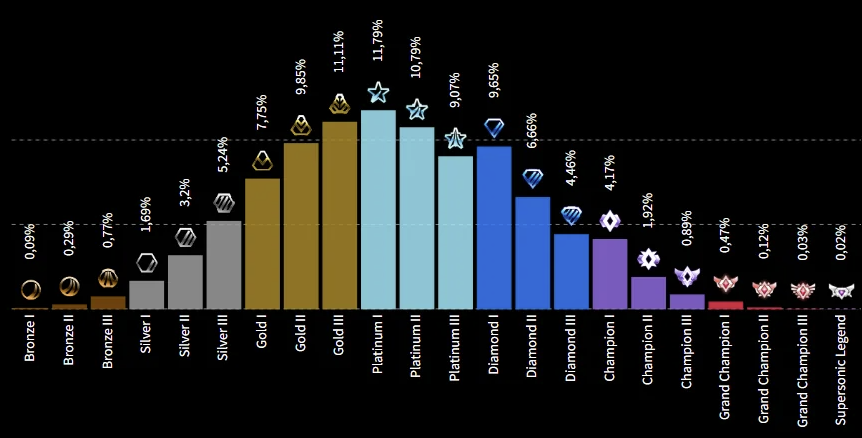
This ranking distribution (similar across many online competitive games) has some unique insights and implications. Firstly, note that a player of average skill is Platinum, a middling rank. Originally, player distribution in competitive games tended to have a leftward-skew, whereby the majority of the playerbase could be found in the lower ranks. Over time, however, this has changed to reflect a more standard distribution, such as in the figure above. This is often attributed to “rank inflation”, which occurs over time for a plethora of reasons, but similar distributions emerge even in new competitive titles (such as Overwatch in 2016), suggesting that this shape is partially a conscious choice by the developer since they ultimately determine how ranking is quantified.
Developers likely propagate this effect to mitigate the mental stresses associated with low leaderboard placement whilst maintaining competitive enthusiasm. For example, in the above distribution, a bottom 15th percentile player is still Gold. This player will likely psychologically prioritise their rank over their actual relative skill level, taking solace that they are several ranks higher than the lowest players. Meanwhile, the top end still carries significant rarity and prestige, with under 1% of the playerbase filling out the top four ranks.
Furthermore, ranking brackets create context. Recall from earlier that users are more likely to compare themselves to their direct peers or groups than to strangers. Ranking brackets are artificial groups, resulting in a pseudo-relative leaderboard where users subconsciously adjust their short-term goals to compete against their bracket peers rather than worrying about how far they are from the top, alleviating associated mental stresses.
Across all skill levels, this ranking system and distribution encourages engagement and competitiveness, and instructional designers could transpose many of the above concepts into leaderboards in a learning environment. However, it might be worth considering the ethical implications of how psychological biases, especially ones potentially tied to self-worth, can be artificially curated or manipulated by developers.
Hybrid Leaderboards
As discussed in the previous blog, absolute and relative leaderboards are not strictly mutually exclusive, nor are they the only way of categorising leaderboards. Many online games create more nuanced leaderboards, using features found in both absolute and relative leaderboards simultaneously as well as a myriad of other techniques to drive engagement and competition.
Case Study: Secret Leaderboards

For example, the racing game Trackmania uses a hybrid of absolute and relative leaderboards in its “Weekly Shorts” gamemode. Many of the principles applied are alluded to in work from Bai et al. (2021), although some are expanded further in this real-world case. The Weekly Shorts gamemode is a casual mode where players race for the best time on a set of five short, simple courses every week, with each week offering a new set of tracks. Here, positions are visible, but the ranking metric (completion time, in this case) is hidden. This sense of mystery might foster engagement, especially at the top end, where players near first are unsure of how measurably close they are to pole position.
It combines concepts from both absolute and relative leaderboards. The top five players are permanently displayed regardless of user ranking, offering the universal prestige associated with high ranks. Meanwhile, only those of proximal rank are shown around a player, and, notably, players cannot determine how many positions rank below them. This feature, combined with the fact that they cannot see how far away they are from the top ranks by any quantifiable metric, results in players revising their standard. Instead of comparing themselves to the best performers and becoming discouraged, they focus instead on localised placement; trying to beat out their direct competition or improving their own rank for the sake of it rather than to “close a gap”.
Finally, these leaderboards are locked after only a week, resulting in increased engagement as players rush to post their times. This also creates an arbitrary reset, providing a fresh start every week for players who may have disliked that week’s tracks or felt too behind to compete. This sense of novelty, alongside the understanding that Weekly Shorts is intended as a low-stakes, casual gamemode that complements the more serious official racing campaigns in Trackmania, likely encourages player retention. This is supported by its positive reception and popularity amongst the playerbase and content creators.
Supplementary Gamification: Rewards
Incentives and rewards, both common features of gamification, are used to supplement leaderboards in online games. When a player achieves a rank at the end of a “competitive season” – an arbitrary timeframe, usually a few months in length – they are rewarded with a plethora of rank-specific rewards. These can include visual flairs, titles, and cosmetic vanity rewards that players can show off in-game. Rewards also have a hierarchy, with higher ranks tending to reward items that are flashier or noticeably higher quality. In some cases, high-tier rewards have tangible, real-world value, such as prizes with monetary worth or actual medals and trophies. Many large online competitive games also have “Esports” circuits, where top players compete in in-person tournaments around the world for glory and huge prize pools.
Nicholson (2012) states that users are receptive to rewards so long as they feel earned and are meaningful to obtain. If developers are successful in achieving both criteria, player performance and engagement increase significantly. Generally, this system has proven largely successful, with players often proudly displaying their achievements both in-game and on social media whilst coveting and striving towards the greater rewards of higher ranks.
Lessons Learned for Instructional Design
Instructional designers might take inspiration from online game leaderboards to supplement their work. As an example, let’s look at how Interserv has implemented several of the ideas discussed in this blog into leaderboards on The Cove.
Case Study: The Cove
The Cove has many different leaderboards. Alongside the standard overall leaderboard, there are leaderboards for each month and year, as well as leaderboards for “Challenges”. Challenges are another form of gamification, which are sets of specific tasks curated by The Cove. Generally, these tasks have been highlighted as particularly important for learning, such as browsing specific resources that aid in advancing a user’s career.
In short, Challenges can be used to direct learners towards content that will impact them the most. Creating a unique leaderboard for each Challenge is designed such that users view them in a standalone capacity, encouraging them to participate through the offer of a fresh start climbing rankings. This is supplemented by unique cosmetic rewards obtained upon “completing” the Challenge. These are visual flairs that are shown on both the leaderboard and user’s profile.
Consequently, Challenge leaderboards create a novel ranked bracket intended to foster engagement in tandem with other forms of supplementary gamification. The monthly and yearly leaderboards operate similarly, using the notion of time-limited leaderboards to stimulate engagement in conjunction with personalised rewards; Verified Users who win monthly leaderboards receive real-world prizes.
Ultimately, leaderboards offer significant potential for learners, as we have discussed over these two blogs. At Interserv, we are committed to designing leaderboards while onboarding lessons learned from both academia and modern video game metasystems to enrich user experience.